Medical records administrators do a lot of work, from patient charting to medicine charting, and all the ancillary documentation, and sometimes it's easy to get lost in the paperwork. Having an electronic medical record (EMR) or electronic health record (EHR) can help with paperwork and give you and your team more time for your practice and for managing patients.
What are the real advantages and disadvantages of adopting an EHR or EMR? Is moving from paper charts to EMRs worth the investment? We explore the advantages and disadvantages of EHR and EMR systems.
What are electronic medical records?
EMRs are the digital version of a patient's record. This contains a patient's medical and treatment history in a particular practice over time. Electronic documentation streamlines patient care by efficiently managing tasks such as appointment scheduling, follow-ups, test updates, and prescription writing.
There are important differences between EMRs and EHRs, and EMRs are most effective when integrated into a comprehensive EHR system. For providers in behavioral health, mental health, and addiction treatment, Zoobook offers a solution designed specifically to meet the needs of these specialties.
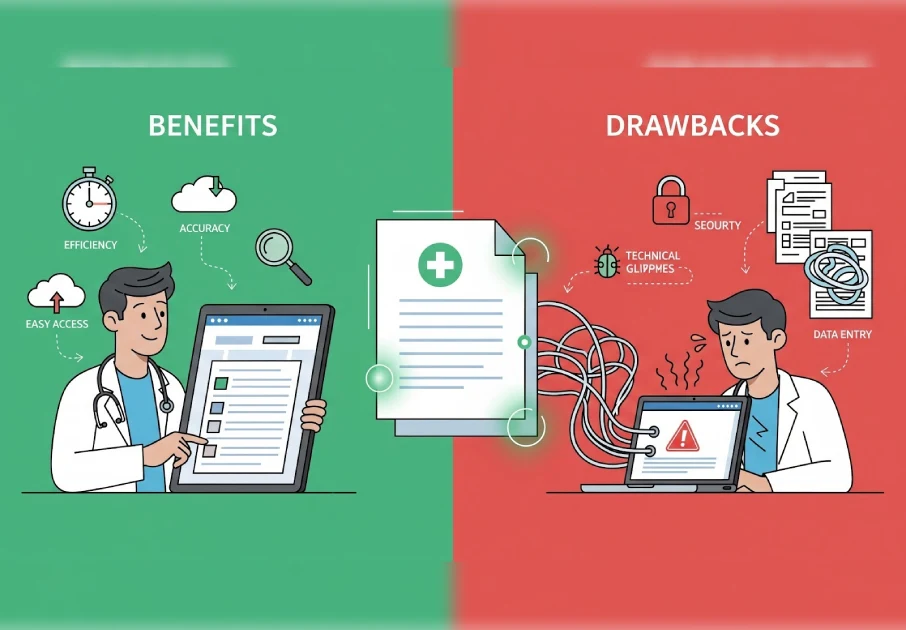
What are the benefits of electronic medical records?
With the standardization of files via EMR, access is streamlined, making internal operations more efficient to manage. There will also be fewer documentation errors in a patient's file due to misspellings or illegible handwriting.
Records are consolidated into one system with customizable features. Depending on your EHR, this may mean the patient's medical history, billing information, and even staff member records are all kept in one place.
Backup systems are in place, making it less likely for files to be destroyed or lost.
Since all the patient's medical records are in one place, it's hard to omit patient information, especially if you're relaying details from one health worker to another.
As you keep up with the digital world, medical information is more accessible to you and the patient. Passwords and other safety features help to secure patient privacy.
What are the disadvantages of electronic medical records?
- Time-consuming documentation processes might be why electronic medical records are bad. Converting paperwork into EMR can really take a lot of time. Choose an EHR with smart tools to help you with patient intake.
- Not all the members of your staff can work a computer well. This is when the user interface and user experience come into place. Make sure you choose an EHR system that knows how clinicians work. Zoobook's user-friendly interface makes it easy for team members to use and engage with.
- With the switch from paper to digital, updating computer hardware may be more frequent to ensure your EMR works efficiently.
- There can be configuration challenges, such as being unable to create templates for each area of practice. It is best to have a system built specifically for your health sector.
- There's a lot of money involved in upgrading from paper to EMR. Aside from upgrading hardware, there's also the cost of the software. Make sure you choose one that can cater to your needs while keeping it in your budget.
With the advent of a modern solution, medical records administrators shouldn't be burdened with the distress of patient charting, medicine charting, and other on-paper tasks. Although there are concerns, there are also benefits to public adoption of EMR. In going through this article on EMR pros and cons, there are definitely a lot of things to consider. But one thing's for sure: transitioning from paper to EMR is a lot easier with an EHR system like Zoobook Systems, the most user-friendly AI-powered EHR on the market.